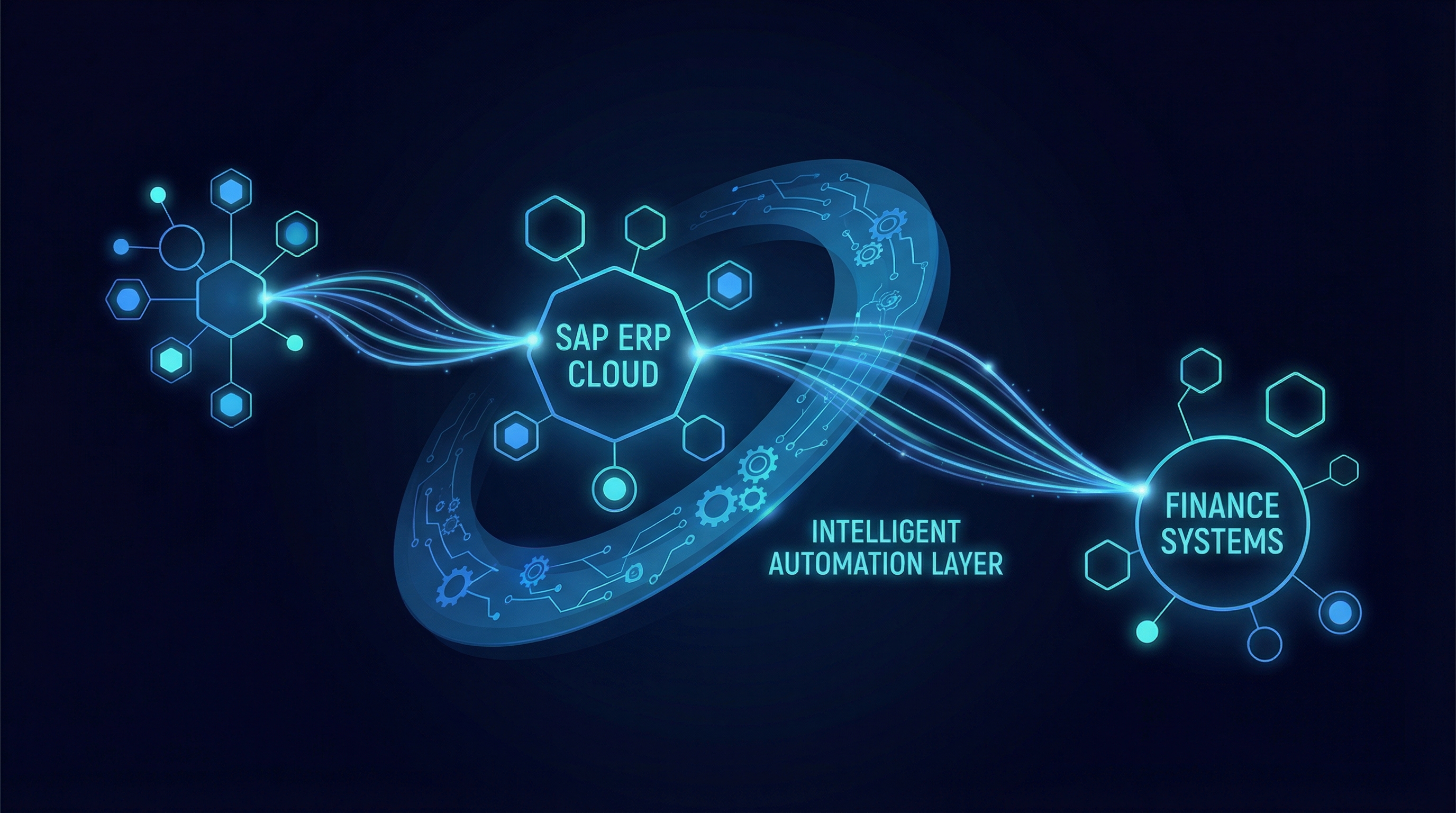
If you've spent any time with enterprise technology, you've heard the promise: implement an ERP, consolidate your systems, and operational efficiency will follow.
For many companies, that promise was half-delivered. ERPs are excellent at what they do — maintaining master data, processing transactions, generating reports. They are systems of record, and good ones at that.
But here's what nobody talks about at the ERP vendor conference: the most time-consuming, error-prone work in most enterprises doesn't happen inside the ERP. It happens between systems.
The Space Between Systems
Consider a typical procure-to-pay cycle. A purchase order is created in the ERP. A supplier sends an invoice — sometimes via email, sometimes via a portal, sometimes as a PDF. Someone verifies the invoice against the PO and goods receipt. Discrepancies are flagged, investigated, resolved. Approvals are obtained. Payment is processed.
The ERP handles the bookends — the PO and the payment. But everything in between? That's often a manual, multi-step process involving email chains, shared folders, spreadsheets, and tribal knowledge about "how we do things."
That middle space — the connective tissue between systems — is where 60-80% of operational processing time goes. And it's precisely where ERPs were never designed to operate.
Why More ERP Isn't the Answer
The natural instinct when processes break down is to extend the ERP. Add more modules. Customise more workflows. Implement more integrations.
This works up to a point. But ERP customisation is expensive, slow, and creates upgrade dependencies that compound over time. Every custom workflow you build in your ERP is a workflow you'll need to re-validate every time you upgrade.
More importantly, ERPs think in transactions. They don't think in documents, context, or judgment. When a supplier invoice arrives in a non-standard format, the ERP can't read it. When a compliance requirement changes across jurisdictions, the ERP doesn't know. When an approval chain needs to flex based on risk level, the ERP follows its static rules.
The Intelligence Layer Concept
An intelligence layer sits between your systems and your people. It doesn't replace the ERP — it makes the ERP more useful by handling the work that ERPs can't:
- Document intelligence: Reading, extracting, and validating information from invoices, contracts, forms, and compliance documents — regardless of format or language
- Workflow orchestration: Routing work to the right people at the right time, with the right context, based on rules that can adapt
- Operational intelligence: Turning the data flowing through your processes into insights that drive decisions — not just reports that describe the past
The key distinction: an intelligence layer works with your existing systems. It reads from your ERP, writes back to your ERP, and handles everything that happens in between.
What This Looks Like in Practice
A multinational manufacturer we worked with had three ERPs across four countries. They'd spent two years trying to consolidate into one. The project was over budget, behind schedule, and generating resistance from regional teams who'd built their operations around local systems.
We deployed an intelligence layer in 6 weeks. It didn't touch their ERPs. Instead, it automated the document processing, compliance checking, and exception handling that happened between their systems. The result: 70% reduction in processing time for cross-border invoices, with complete audit trails.
The ERP consolidation project was eventually scaled back. Not because the intelligence layer replaced it, but because it solved the operational pain that was driving the urgency to consolidate in the first place.
The Practical Question
The question isn't whether your ERP is good enough. It probably is — for what it's designed to do. The question is: what's happening in the space between your systems, and how much is it costing you?
Let's explore what an intelligence layer could do for your operations