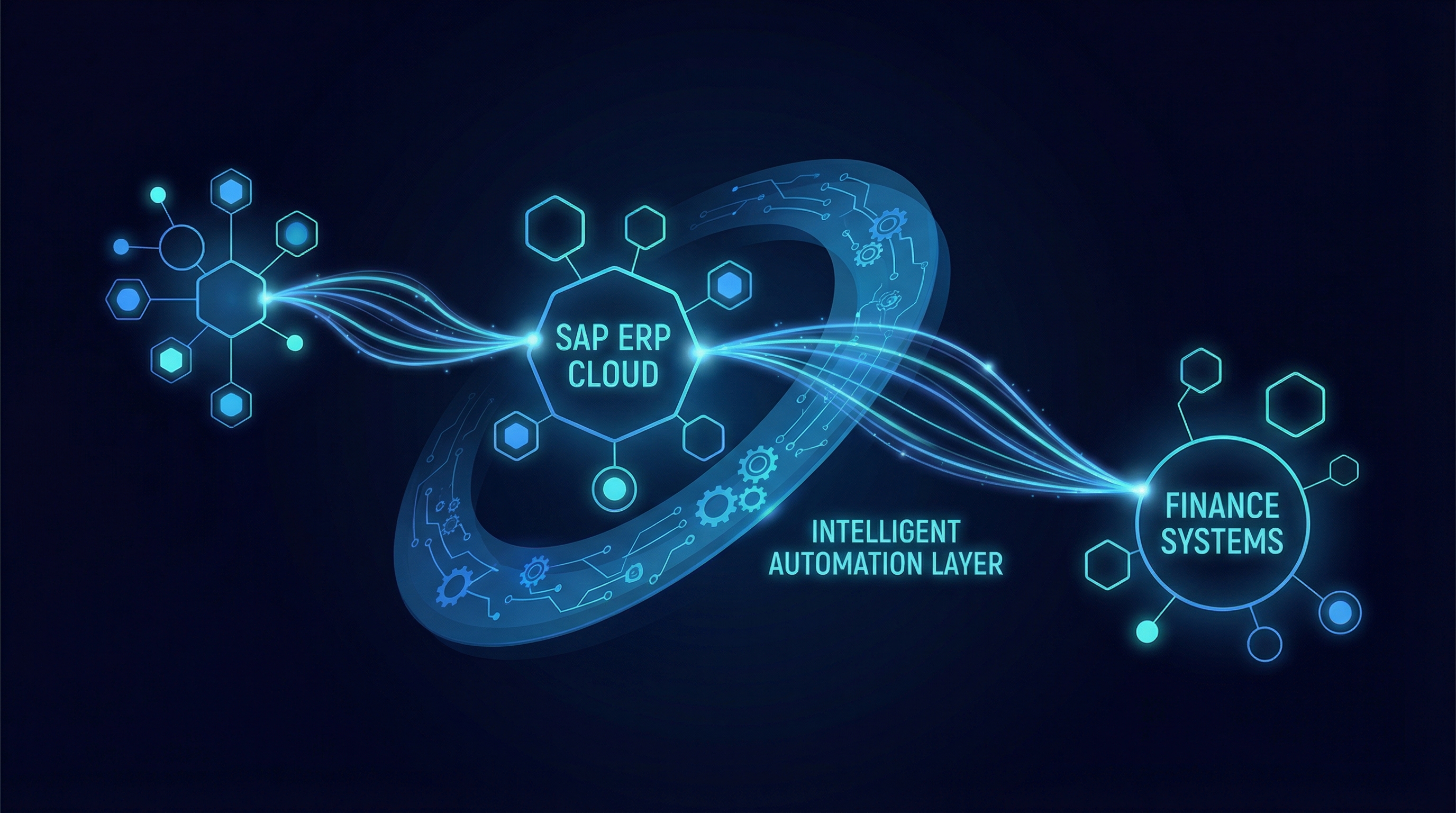
Every few years, a new platform promises to consolidate your enterprise operations into one unified system. And every few years, enterprises discover that the consolidation takes longer than expected, costs more than budgeted, and ends with people still using spreadsheets for the critical tasks.
The pattern isn't a failure of any specific platform. It's a misdiagnosis of the problem.
Here are five signs that what you actually need isn't a new system — it's an intelligence layer that makes your existing systems work together.
1. People Are Your Integration Layer
The most expensive integration middleware in your enterprise isn't software. It's the operations team members who spend their days copying data from one system to another, reconciling records across platforms, and translating between formats.
When someone downloads an invoice from email, types the details into the ERP, cross-references the PO in a separate system, and then updates a shared spreadsheet to track the status — that person is acting as a human integration layer. They're doing the work that an intelligent connection between systems should do automatically.
If this describes your operation, a new platform won't fix it. You'll just have different systems that still need the same human connective tissue.
2. Your Monthly Close Is a Fire Drill
If month-end close involves a week of frantic reconciliation, manual journal entries, and people working weekends to match records across systems — the problem isn't your finance system. It's the lack of continuous reconciliation throughout the month.
An intelligence layer transforms close from a periodic event into a continuous process. Transactions match in real time. Discrepancies surface when they happen, not 25 days later. By month-end, there's nothing to reconcile because reconciliation has been happening all along.

3. Compliance Is a Quarterly Panic
When audit time arrives, does your team scramble to compile documentation, reconstruct approval chains, and generate reports from multiple systems? That's a sign that your operational workflows don't have audit traceability built in.
An intelligence layer logs every action, decision, and data transformation automatically. Compliance reporting becomes a query, not a project. And auditors get the transparency they need without your team dropping everything to produce it.
4. You Upgraded Your ERP But Nothing Changed
This is the most telling sign. Your organisation invested significant time and money in an ERP upgrade or migration. The new system is faster, more modern, and has better features. But the operational bottlenecks are the same — because the bottlenecks were never inside the ERP.
The bottlenecks are in the spaces between systems: the email-based approval chains, the manual data entry from documents into the system, the cross-referencing between ERP data and external documents. A better ERP doesn't fix these gaps. An intelligence layer does.
5. Your Operations Team Is Growing Faster Than Your Revenue
If headcount in operations, finance, or compliance is growing proportionally with transaction volume — or faster — that's a scaling problem. And it's a sign that your processes are fundamentally manual.
Technology should enable your team to handle growing volume without proportional headcount growth. If it's not doing that, the missing piece isn't more technology. It's intelligent automation of the workflows that connect your existing technology.
The Intelligence Layer Alternative
An intelligence layer sits above your existing systems and automates the connective workflows between them. Your ERP stays. Your SharePoint stays. Your finance systems stay. But the manual work of moving data between them, validating it, routing it for approval, and logging it for compliance — that becomes automated.
No migration. No rip-and-replace. No 18-month implementation timeline. Working value in weeks.
Recognise any of these patterns? Let's explore what an intelligence layer could do for your operations.
See Intelligence Layers in Action
- APAC Consumer Goods Trade Operations — After an ERP upgrade failed to fix operational bottlenecks, the intelligence layer approach delivered measurable improvement in weeks.
- Japanese Precision Manufacturer DX — Instead of consolidating 4 regional ERP instances, an intelligence layer across all of them delivered value in 3 months.
- Multinational Invoice Automation — Multi-region, multi-currency invoice processing without replacing any existing financial systems.
Related Reading
- Enterprise AI Without the Rip-and-Replace — The foundational case for intelligence layers over system replacement.
- Why Most Enterprise AI Projects Never Leave the Pilot — Why integration matters more than model accuracy.
- Our solutions — Workflow Automation, Operational Intelligence, and Compliance Architecture.