
Every enterprise AI conversation eventually arrives at documents. That's because documents are the connective tissue of enterprise operations — invoices, purchase orders, contracts, compliance filings, shipping documents, quality certificates. They flow between companies, between systems, and between people.
And despite decades of digitisation efforts, most enterprise document processing still involves a human reading a document, extracting the relevant information, and keying it into a system. Sometimes multiple systems.
The standard response has been OCR — optical character recognition. Scan the document, convert the image to text, done. But OCR is where the real work begins, not where it ends.
The OCR Ceiling
OCR technology has improved dramatically. Modern OCR engines can handle multiple fonts, handwriting, and poor scan quality with reasonable accuracy. The conversion of image pixels to character strings is largely a solved problem.
The problem is that enterprise document processing isn't about character recognition. It's about meaning recognition.
When a finance analyst processes a supplier invoice, they're not just reading text. They're identifying the vendor, matching the invoice to a purchase order, verifying quantities and prices, checking compliance with contract terms, validating tax calculations against local regulations, and routing exceptions to the right approver.
OCR gives you the text. It doesn't give you any of that.
What Document Intelligence Actually Means
Document intelligence is the stack of capabilities that sits on top of text extraction:
Classification: What type of document is this? An invoice, a purchase order, a compliance certificate, a shipping document? Documents don't arrive with labels. The system needs to recognise them.
Extraction: Not just "what does this text say?" but "what are the key-value pairs that matter?" Vendor name, invoice number, line items, amounts, tax calculations, payment terms. Extracted in a structured format that systems can consume.
Validation: Does the extracted data make sense? Does the invoice total match the line items? Is the tax calculation correct for this jurisdiction? Does the PO number match an existing purchase order? Are the quantities within tolerance of the goods receipt?
Cross-referencing: How does this document relate to other documents in the process? A single shipment might generate a bill of lading, commercial invoice, packing list, certificate of origin, and customs declaration. Each document references the others. The system needs to connect them.
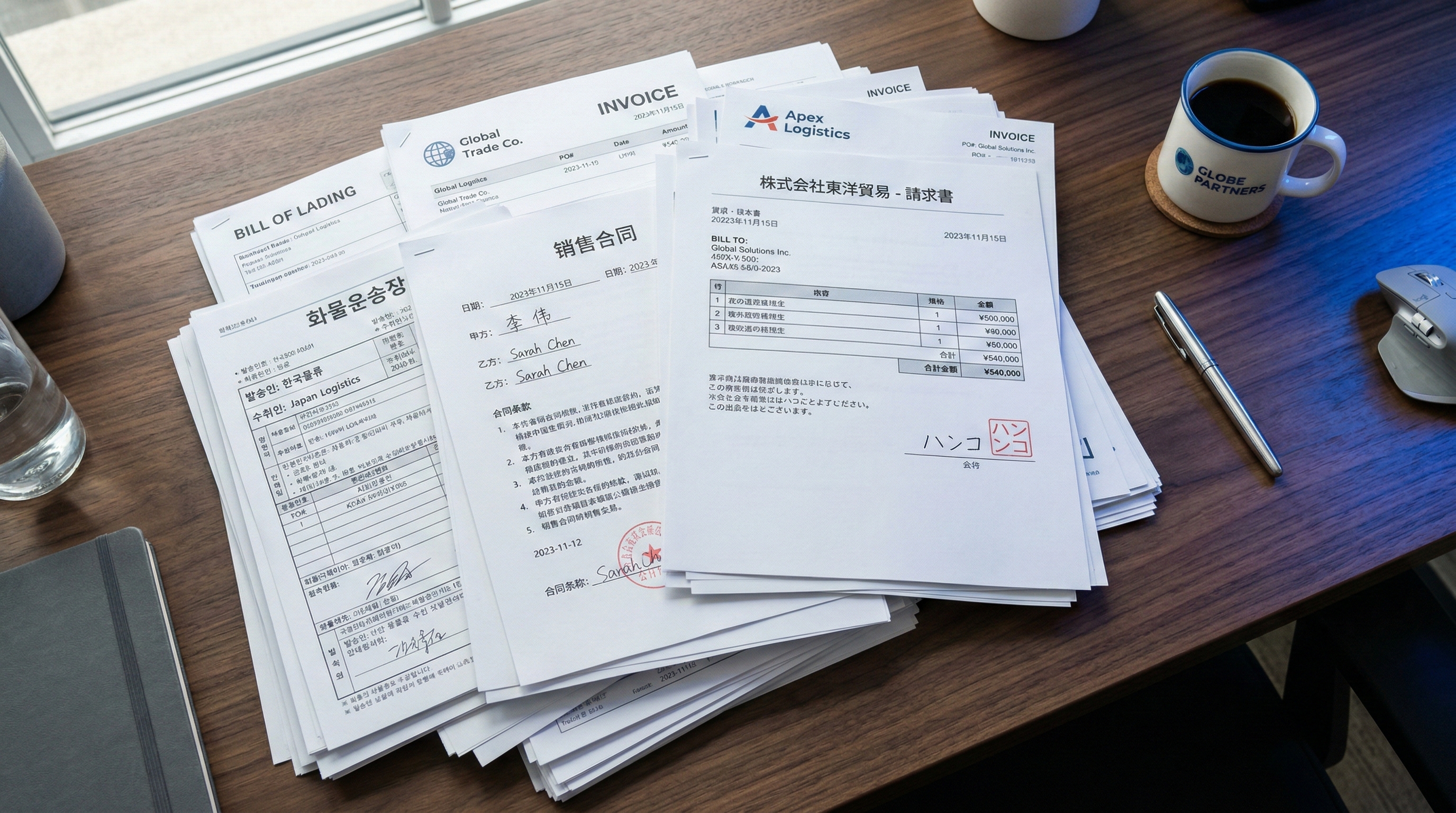
Language handling: APAC enterprises routinely receive documents in English, Chinese (simplified and traditional), Japanese, Korean, Thai, Bahasa, and Vietnamese — sometimes multiple languages in a single document. The system needs to handle all of them without manual language routing.
The APAC Complexity Factor
Document intelligence in APAC is harder than in single-market, single-language environments. Consider a regional trading company processing documents from suppliers across six countries. Each country has different invoice formats, tax rules, compliance requirements, and languages.
A single supplier from Thailand might send invoices in Thai with line items in English and monetary amounts in both THB and USD. A Japanese manufacturer might send documents with a mix of kanji, katakana, and English technical terms. Indonesian regulatory filings follow formats different from Singaporean ones.
The system that handles this isn't doing character recognition. It's doing cultural and regulatory recognition — understanding not just what the text says, but what it means in context.
From Document Processing to Operational Intelligence
The real value of document intelligence isn't faster data entry. It's the operational intelligence that flows from having structured, validated document data integrated into your workflows.
When every invoice is automatically matched to its PO and goods receipt, you can measure supplier performance in real time. When compliance documents are validated against regulatory requirements as they arrive, you can catch issues before they become audit findings. When shipping documents are cross-referenced automatically, you can track the true cost and timeline of every shipment.
Documents aren't just paper to be processed. They're signals to be understood. The enterprises that understand this distinction are the ones building real operational advantage.